


No, SPF moisturizer does not always leave a greasy residue: the finish depends on the formula, your skin’s oiliness, and the products underneath it. A comfortable sunscreen film is normal, but persistent slipperiness, tackiness, and pilling are different problems—and reducing your sunscreen amount is not the right fix.
- Does SPF moisturizer leave greasy residue? Not always; formula texture and skincare layering affect the finish.
- Hada Labo Tokyo SPF skincare combines hydration and sun protection; a matte finish is not guaranteed.
- Choose sunscreen by protection and comfort, not by whether every trace of its film disappears.
- Simplify products underneath sunscreen before changing how much sunscreen you apply.
Does SPF moisturizer leave a greasy residue?
Greasy residue is a possible finish, not an unavoidable feature of SPF moisturizer. Some formulas feel light after application; others leave a richer, more noticeable layer. Your skin and the rest of your morning routine influence that difference.
Start by identifying what you actually notice. Shine alone does not tell you whether a product is greasy, and a dry-touch finish does not prove that you have applied enough protection. If your concern is makeup slipping rather than skin feeling oily, the guide to wearing SPF moisturizer under makeup addresses that separate layering problem.
| Finish or problem | What you notice | Best next move | Limitation |
|---|---|---|---|
| Dewy finish | Visible sheen without persistent slipperiness | Keep the formula if it feels comfortable | It will not look fully matte |
| Greasy residue | An oily, slippery surface that feels uncomfortable | Reassess the formula and rich products underneath | Appearance alone cannot identify the cause |
| Tackiness | A sticky feeling rather than oily slip | Let underlying skincare settle and simplify layering | A lightweight texture does not guarantee zero tack |
| Pilling | Small rolls or flakes form as you rub | Reduce rubbing and review product combinations | Pilling does not reveal how much protection remains |
| White cast | A pale or ashy appearance | Assess the formula’s appearance on your skin | White cast and greasiness are different issues |
Use this distinction when reviewing your routine in 2026. Otherwise, you risk replacing a sunscreen when the real problem is the moisturizer or makeup underneath or above it.
Why this matters
A sunscreen that feels unpleasant is harder to keep in your daily routine. The answer is to find a finish you can wear comfortably while following the label—not to spread a smaller amount until it becomes invisible.
SPF describes protection against sunburn, not how matte, silky, or moisturizing a formula feels. Choose protection first, then find the texture that makes that protection practical. For your 2026 routine, the American Academy of Dermatology’s general guidance is to choose broad-spectrum, water-resistant sunscreen with SPF 30 or higher.
A moisturizing sunscreen also does not automatically require a separate moisturizer beneath it. Let your skin’s comfort guide that extra step instead of assuming every morning needs several hydrating layers.
Why SPF moisturizer feels different on different skin
These factors explain why the same sunscreen can feel comfortable in one routine and heavy in another:
- The complete formula. Sunscreen filters sit within a formula containing other ingredients that affect spread, moisture, and finish. The SPF number does not describe those qualities.
- The product’s texture. Lightweight and fast-absorbing descriptions help you shortlist formulas, but they do not promise a matte result on your skin.
- Your underlying skincare. A rich moisturizer, facial oil, and hydrating serum all add material beneath sunscreen. You do not need every layer simply because each has a different name.
- Your skin’s own oil. Oil appearing later in the day is not necessarily residue left by the sunscreen at application. Notice when the shine begins.
- Heat and perspiration. Sweat changes how your face feels and looks. A comfortable indoor finish does not establish how a sunscreen will feel during outdoor activity.
- Application and rubbing. Repeatedly working products over one another can contribute to rolling or pilling. More rubbing is not a reliable solution to a finish you dislike.
Change one part of the routine at a time. That gives you a useful comparison instead of a completely different set of products with no clear explanation for the result.
SPF 30: protection does not predict greasiness
An SPF 30 moisturizer is not automatically lighter than an SPF 50 moisturizer. The protection number is not a texture rating, and comparing the numbers alone will not tell you which product leaves less shine.
Best for: someone choosing a daily sunscreen that meets the American Academy of Dermatology’s minimum SPF recommendation, provided the product also meets their broad-spectrum and water-resistance needs. Check those claims separately on the current label.
The advantage is straightforward protection combined with the moisturizing properties of the individual formula. The limitation is equally clear: SPF 30 does not promise a particular finish, makeup compatibility, or suitability for your skin.
SPF 50: higher protection does not automatically mean heavier texture
An SPF 50 moisturizer is not inherently greasy simply because its SPF is higher. Evaluate its texture and directions rather than assuming that a lower number will solve an oily finish.
Best for: someone looking for an SPF 50 facial product whose feel works with their routine. The benefit is the product’s labeled protection; the trade-off is that you still need to assess comfort, appearance, and the other protection claims independently.
When comparing facial sunscreens in 2026, keep the conditions consistent. Applying one over facial oil and another directly over clean skin is not a useful comparison of the sunscreens themselves.
How do you reduce greasy residue without using less sunscreen?
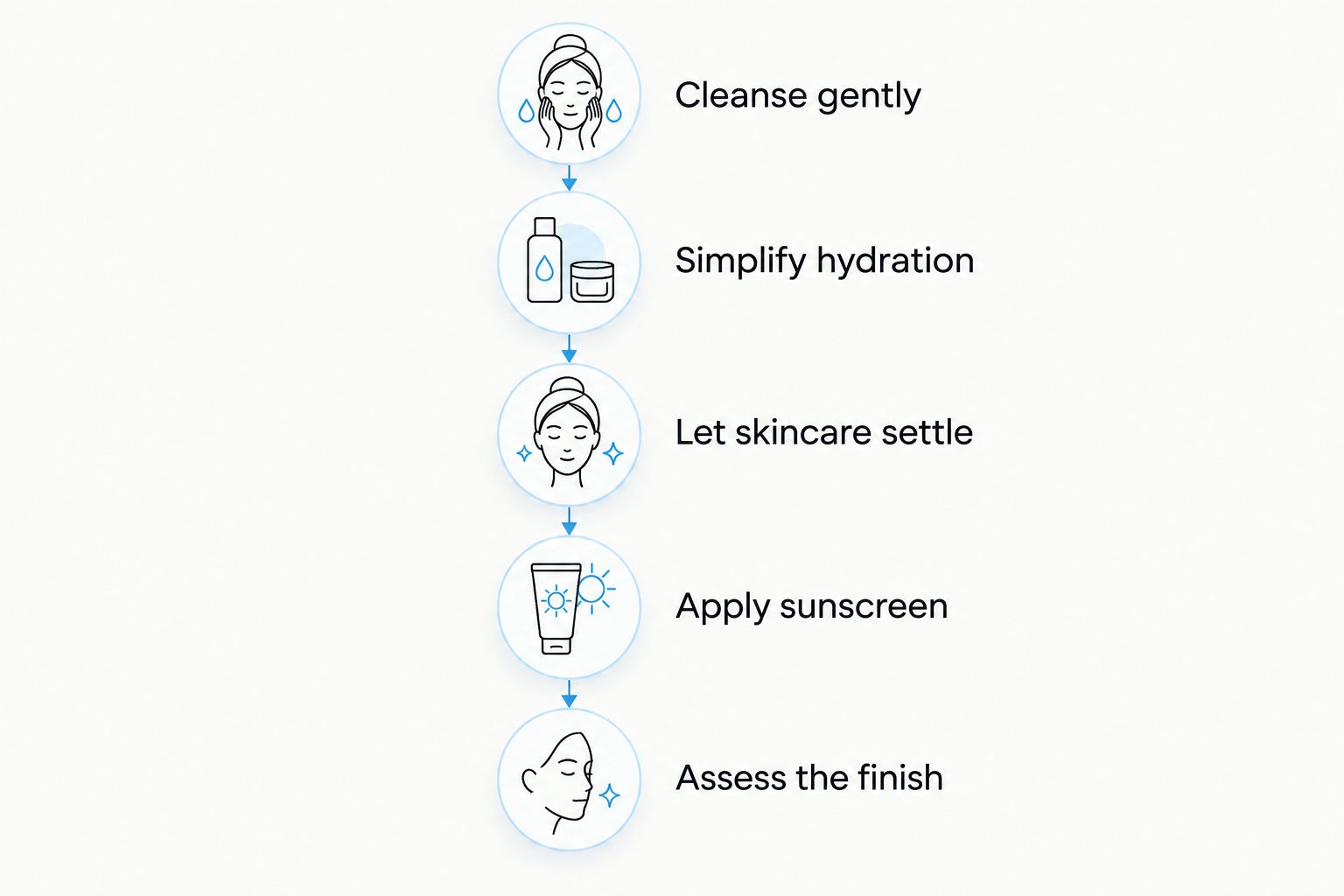
Simplify what goes underneath before cutting back on sun protection. Use this sequence to separate formula feel from a layering problem.
- Cleanse gently. Start with clean skin and rinse cleanser as directed. Scrubbing until your face feels tight is not necessary preparation for sunscreen.
- Simplify hydration. Keep the hydrating steps your skin needs, rather than automatically combining lotion, serum, cream, and oil. If you need a separate moisturizer only on dry areas, apply it there.
- Let skincare settle. Avoid immediately spreading sunscreen through a wet mixture of previous products. Follow any application instructions on your skincare and sunscreen labels.
- Apply sunscreen. Use the amount and method directed on the label, covering exposed skin evenly. Do not mix the sunscreen with moisturizer in your palm to make it feel lighter.
- Assess the finish. Check comfort before adding makeup. Separate oily slip from simple sheen, then notice whether the problem starts immediately or develops later.
If the simplified routine feels better, add back only a product you genuinely miss. If the sunscreen still feels persistently slippery on otherwise comfortable skin, choose a different texture rather than trying to force that formula to suit you.
Do not keep rubbing until every trace of product disappears. Sunscreen needs to remain on your skin, and a visible or perceptible finish does not by itself mean you applied it incorrectly.
Which hydrating facial sunscreens fit this approach?
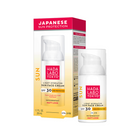
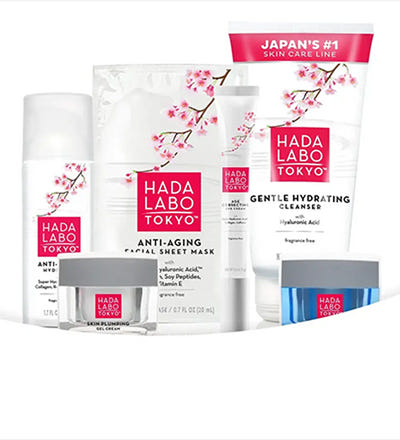
Hada Labo Tokyo SPF skincare suits shoppers seeking hydration alongside sun protection, not a guaranteed matte finish. The two facial sunscreens below pair sun protection with Super Hyaluronic Acid, but their supplied descriptions do not establish an oil-control or matte-finish result.
| Product | Best for | Supported benefit | Limitation |
|---|---|---|---|
| Hada Labo Tokyo Face Sun Cream SPF 30 50ml | A lightweight, fast-absorbing hydrating facial sunscreen | Described as lightweight and fast-absorbing, with Super Hyaluronic Acid | No supplied claim establishes a matte or oil-control finish |
| Hada Labo Tokyo Face Sun Cream SPF 50 50ml | Hydration alongside SPF 50 facial sun protection | Described as hydrating, with Super Hyaluronic Acid | The description does not establish how shiny it looks on your skin |
The 50ml size describes the container, not the amount to use for an application. Follow the current product directions for application and reapplication, and check the label for broad-spectrum and water-resistance information before choosing for outdoor activity.


Treat the texture descriptions as a starting point, not a promise about your complexion. A hydrating formula has a clear purpose, but you still need to decide whether its finish feels comfortable with your other skincare.
Does oily skin still need an SPF moisturizer?
Oily skin still needs sun protection, but it does not necessarily need a separate moisturizer beneath a moisturizing sunscreen. Choose the combination that leaves your skin comfortable without unnecessary richness.
Oiliness and dehydration are different concerns. Removing every hydrating step is not automatically the answer to shine; simplifying an overloaded routine is a more useful first comparison.
If breakouts accompany the greasy feeling, do not assume the shine identifies the cause. Review the full routine and seek dermatology advice for persistent or worsening acne rather than repeatedly adding drying products.
Does a shiny finish mean SPF moisturizer is not working?
A shiny finish does not tell you whether sunscreen is working. Protection depends on the product’s tested claims and correct application, not whether your skin looks matte.
Likewise, an invisible finish does not confirm adequate coverage. In 2026, judge sunscreen by its label, application instructions, and your ability to wear and reapply it—not by appearance alone.
Should you blot or powder over greasy sunscreen?
Powder can change the appearance of shine, but it does not correct an uncomfortable formula or replace your sunscreen application. Avoid vigorous rubbing or blotting that removes the layer you have just applied.
If you repeatedly need to remove product to tolerate the finish, change the formula or simplify the skincare underneath. Makeup should be an optional finishing step, not a way to make an unsuitable sunscreen bearable.
Keep protection intact when adjusting your routine
The American Academy of Dermatology’s general outdoor guidance is to reapply sunscreen every 2 hours and immediately after swimming or sweating. Follow your product’s directions, including its water-resistance limits; a comfortable finish does not extend its protection schedule.
For a practical 2026 morning routine, keep sunscreen as the final skincare step before makeup. Apply it before going outdoors according to the label, and use shade, clothing, and a hat alongside sunscreen rather than relying on the facial product alone.
Do not dilute, wipe away, or underapply sunscreen to obtain a matte finish. If you dislike the finish at the directed amount, that is a reason to find a better-fitting formula—not evidence that your skin needs less protection.
FAQ
Does SPF moisturizer leave greasy residue on everyone?
No, SPF moisturizer does not leave greasy residue on everyone. The complete formula, your skin’s oiliness, and the skincare underneath affect how it feels.
Is SPF 50 moisturizer greasier than SPF 30?
SPF 50 moisturizer is not automatically greasier than SPF 30. SPF describes sunburn protection, not the product’s texture or finish.
Can I skip moisturizer under a moisturizing sunscreen?
You can skip a separate moisturizer if the moisturizing sunscreen leaves your skin comfortable. If you still feel dry, adjust the hydration underneath without reducing your sunscreen application.
Does hyaluronic acid make sunscreen oily?
Hyaluronic acid is a humectant, not an oil. Its presence does not establish whether the complete sunscreen formula will feel greasy, sticky, or light.
Can I mix sunscreen with moisturizer to make it less greasy?
Do not mix sunscreen with moisturizer to change its finish. Apply sunscreen separately according to its directions so you do not alter the formula or its application.
Why does my SPF moisturizer roll into little flakes?
Little rolls or flakes are pilling, not necessarily grease. Simplify underlying skincare, let it settle, and avoid repeatedly rubbing the layers together.
Should I use less sunscreen if my face looks shiny?
Do not use less sunscreen to reduce shine. Follow the label and choose a different texture if the directed application feels uncomfortable.
One last thing
A sunscreen does not need to disappear completely to be comfortable. The useful distinction is between a light, wearable film and a finish that stays slippery, sticky, or unpleasant enough that you want to remove it.
Before replacing your next bottle, try the same sunscreen with fewer optional products underneath. Keep the sunscreen application consistent and compare the result before makeup. That small change tells you more about the cause than buying another hydrating layer to solve a routine that already feels too heavy.


