


There is no brand-wide yes or no: whether Hada Labo sunscreen leaves a white cast depends on the exact formula and how its finish looks on your skin. Judge the sunscreen at its recommended application amount, not from its SPF number, the colour of the cream, or a thin hand swatch.
- Hada Labo Tokyo sunscreen needs a formula-specific assessment; the brand name does not establish an invisible finish.
- For the hada labo sunscreen white cast question, check persistent colour change in daylight, not shine alone.
- SPF 50 describes protection against sunburn, not whether sunscreen looks white on your skin.
- Never reduce sunscreen application or mix it with moisturizer to hide a white cast.
Does Hada Labo sunscreen leave a white cast?
A particular sunscreen can leave a visible pale film, but you cannot predict that result from the Hada Labo name alone. The useful question is whether the exact sunscreen you plan to use changes your skin colour after you apply it according to its directions.
Start by distinguishing the products. These facial sunscreens have different SPF labels; neither label establishes a cast-free finish.
| Facial sunscreen | Stated size and SPF | Best for this comparison | What the label does not establish |
|---|---|---|---|
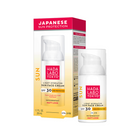
| Face Sun Cream SPF50 50ml | 50 ml; SPF 50 | Identifying the higher-SPF facial option | Whether its finish is invisible on your skin tone |
| Face Sun Cream SPF30 50ml | 50 ml; SPF 30 | Identifying the SPF 30 facial option | Whether it leaves less cast than the SPF 50 option |
A higher SPF is not evidence of a stronger white cast. Formulation determines appearance. Choose the protection your circumstances require, then assess the finish without reducing the amount you apply.
For a 2026 purchase, match any review to the exact product name and current packaging. A review of another sunscreen is not a reliable answer about the tube in your hand.
Why this matters
An uncomfortable finish creates a practical problem: you might apply less sunscreen to make it look better. That changes the protective film, rather than solving the cosmetic mismatch.
SPF testing uses an application density of 2 mg/cm², as specified in the US Food and Drug Administration's sunscreen SPF testing procedure. That laboratory standard explains why a barely visible smear is not a meaningful demonstration of how sunscreen looks at a protective application amount. Follow your product's directions for everyday use.
Keep appearance and protection separate. A sunscreen can look shiny without looking white, and an invisible finish does not prove adequate coverage or broad-spectrum protection.
If your main concern is foundation sitting well over sunscreen, the guide to wearing SPF moisturizer under makeup addresses the next step. First establish what the sunscreen looks like on its own.
Face Sun Cream SPF 50: assess the finish separately
The SPF 50 facial sunscreen comes in a 50 ml format. Those details identify the product and its labelled sunburn protection; they do not describe its transparency, texture after application, or performance under foundation.
The advantage of the SPF label is that it gives you a defined protection category. The limitation is that it cannot answer a cosmetic question. Do not treat SPF 50 as shorthand for either a heavy white film or an invisible finish.
For your 2026 sunscreen comparison, look for observations made with this exact product on a skin tone similar to yours. A useful demonstration shows application, the settled finish, and the face beside the neck in consistent lighting. A product photograph or an immediate swatch answers much less.
Assess the SPF 50 sunscreen on its own before changing your whole morning routine. Otherwise, you cannot tell whether a visible residue comes from the sunscreen or the layers underneath it.
Face Sun Cream SPF 30: do not assume less cast
The SPF 30 facial sunscreen also has a stated size of 50 ml. Its lower SPF label does not establish that it looks clearer, feels lighter, or works better under makeup than the SPF 50 product.
The advantage of checking this option separately is precision: you evaluate a specific sunscreen rather than treating the range as interchangeable. The limitation remains the same. Its name and SPF do not settle the white-cast question.
Do not move from SPF 50 to SPF 30 solely because you expect less visible residue. Compare the actual finish and read the protection directions on each product. Appearance is one selection criterion, not a replacement for suitable sun protection.
Is it white cast, pilling, or shine?
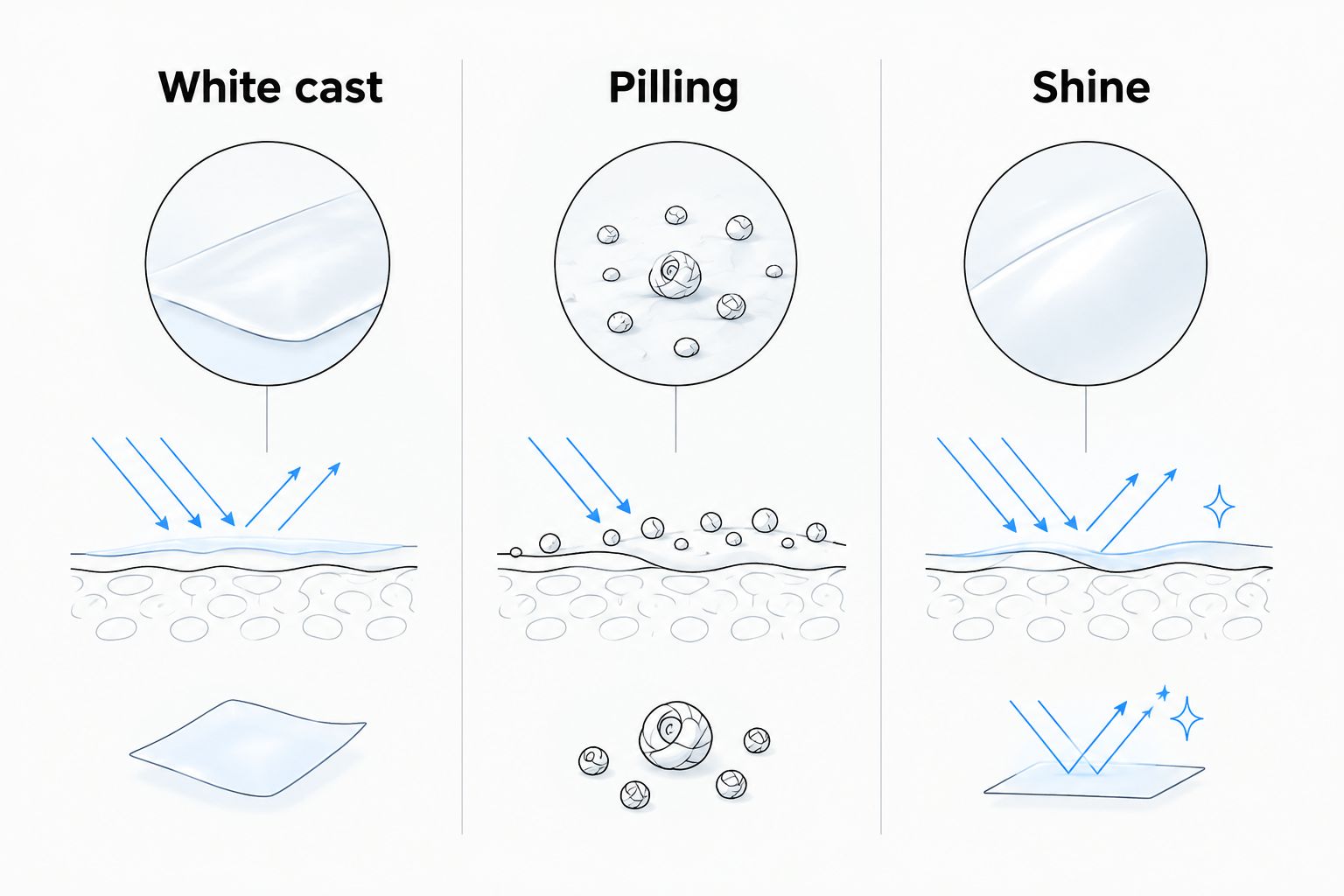
White cast changes apparent skin colour; pilling creates particles; shine reflects light. These are different observations, and each calls for a different response. Look closely before trying to fix the wrong problem.
| Observation | What you see | Useful next move | Limitation of the observation |
|---|---|---|---|
| White cast | A persistent pale, grey, or chalky film across the skin | Check the settled finish in daylight and compare with your neck | Lighting and camera settings can exaggerate colour differences |
| Pilling | Small rolls, flakes, or crumbs that appear during spreading | Simplify the underlying routine and avoid repeated rubbing | Particles do not identify which layer caused the problem |
| Shine | Reflections on raised areas such as the forehead and cheekbones | Change your viewing angle and inspect the underlying skin colour | A glossy finish can coexist with a white cast |
A pale cream as it leaves the tube is not automatically a white-cast sunscreen. What matters is the film left on your skin after application. Likewise, a bright highlight on your cheekbone is not enough to diagnose a cast across your face.
Check the jawline, eyebrows, hairline, and sides of the nose as well as the centre of your face. These areas help you notice uneven spreading or residue caught in hair. Do not keep rubbing indefinitely to force the finish to disappear.
Why sunscreen white cast varies
The same broad product category does not produce the same finish on every person. These established formulation and application factors explain why a universal brand verdict is unreliable:
- UV-filter formulation. Zinc oxide and titanium dioxide can leave visible residue. Particle properties, dispersion, and the surrounding formula affect how noticeable that residue looks.
- Skin tone. A pale film creates more visible contrast against deeper skin tones. A convincing result on lighter skin does not establish the same result on darker skin.
- Application amount. A thin swatch can conceal a finish that becomes apparent at the amount needed for protection. Test realistically rather than spreading the product almost to nothing.
- Underlying skincare. Interactions between layered formulas can affect spreading and produce pilling. That residue is not necessarily a white cast from the sunscreen itself.
- Lighting and photography. Direct flash, strong reflections, and camera exposure affect perceived brightness. Compare the finish in consistent daylight before drawing a conclusion.
This is also why a 2026 review should name the product it assesses. A brand-level statement cannot tell you which formulation, application method, skin tone, or lighting produced the result.
Hyaluronic Acid attracts water and supports hydration, but its presence does not certify a transparent sunscreen finish. Ingredient-led hydration and visible residue are separate questions.
How do you check sunscreen for white cast at home?
Use a simple comparison that preserves normal application. You are checking cosmetic suitability, not conducting an SPF test.
- Confirm the product. Read the full name and SPF on your packaging. Match them to any demonstration or review you use.
- Simplify the base. Begin with a familiar, uncomplicated skincare routine. Avoid introducing a new serum, moisturizer, primer, and sunscreen together.
- Apply as directed. Cover the areas specified on the label and spread evenly. Do not deliberately under-apply to obtain a clearer finish.
- Let the film settle. Follow any timing instructions on the packaging. There is no universal settling time that establishes every formula's final appearance.
- Inspect in daylight. Look at the face and neck together, then change your viewing angle to separate reflection from colour change.
- Check your makeup. Once you understand the sunscreen alone, try your usual makeup over it. Note colour change, particles, and shine separately.
Keep your camera angle and lighting consistent if you take photographs. Turn off beauty filters, and do not compare a flash photograph with an unlit mirror view. Those changes make it harder to interpret the result.
For a useful 2026 routine check, change only the layer you are investigating. If you remove several products at once, an improved finish will not tell you which interaction mattered.
Can you reduce white cast without reducing protection?
You can improve uneven application, but you cannot guarantee that technique will make every sunscreen transparent. Spread the recommended amount carefully and follow the label. If the settled film remains visibly pale, choose a different suitable formulation rather than using less.
Do not mix sunscreen with moisturizer, serum, facial oil, or foundation in your palm. Mixing changes the formulation and prevents you from relying on the original product's labelled protection in that mixture.
If you see particles rather than a uniform pale film, investigate pilling. Simplify optional layers underneath, let them settle, and avoid repeatedly rubbing the same area. Preserve the sunscreen application rather than scraping the surface clear.
An unacceptable finish is a reason to change sunscreen, not a reason to under-apply it. A comfortable formula helps you maintain the routine without making appearance compete with protection.
Is hydrating sunscreen automatically cast-free?
No. Hydration describes a skincare benefit, while white cast describes the appearance of the applied film. A product can be hydrating and still leave visible residue.
Hada Labo Tokyo's skincare range focuses on Hyaluronic Acid and Japanese-inspired hydration routines. Hada Labo Tokyo is best for shoppers seeking Hyaluronic Acid-led skincare, not shoppers relying on the brand name as proof of invisible sunscreen.
That distinction keeps the recommendation useful. Explore the hydration category for its stated purpose, and judge sunscreen finish by the exact sunscreen you use. Neither Japanese inspiration nor a hydrating ingredient substitutes for a skin-tone-specific assessment.
Does white cast mean sunscreen is working better?
No. Visible whiteness is not a measure of protection, and an invisible film is not evidence that protection is absent. Read the SPF, broad-spectrum information, and application directions rather than judging protection by colour.
The SPF 50 and SPF 30 labels identify different labelled sunburn-protection levels. They do not establish water resistance, application comfort, or cast-free performance. Check those characteristics separately on the exact product.
FAQ
Does Hada Labo sunscreen leave a white cast on dark skin?
A brand-wide claim cannot establish the finish on dark skin. Assess the exact sunscreen at its directed application amount, because pale residue is more visible when it contrasts with a deeper skin tone.
Is Hada Labo Tokyo SPF 50 guaranteed to be invisible?
SPF 50 does not guarantee an invisible finish. The SPF label describes sunburn protection, while the formula and its appearance on your skin determine visible cast.
Does SPF 30 leave less white cast than SPF 50?
SPF 30 does not automatically leave less white cast than SPF 50. Compare the exact formulations rather than using the protection number to predict appearance.
Why does my sunscreen look white when I first apply it?
The initial appearance of a cream does not necessarily represent its settled finish. Spread it according to the directions, let the film settle, and inspect for persistent colour change in daylight.
Is sunscreen pilling the same as white cast?
Pilling is not the same as white cast. Pilling creates rolls or particles, while white cast creates a persistent pale, grey, or chalky appearance across the skin.
Can I use less sunscreen to stop the white cast?
Do not use less sunscreen to hide a white cast. Follow the application directions and choose another suitable formulation if the correct application leaves a finish you dislike.
Can I mix sunscreen with Hyaluronic Acid serum?
Do not mix sunscreen with Hyaluronic Acid serum before application. Apply skincare separately and preserve the sunscreen formulation rather than diluting or altering it.
Does a white-cast-free sunscreen still protect my skin?
An invisible finish can still provide sun protection when the product has appropriate labelled protection and you use it correctly. Visible whiteness is not a reliable measure of SPF or coverage.
One last thing
A nearly invisible hand swatch is the wrong shortcut for choosing facial sunscreen. Hands differ from your face in texture, underlying skincare, and how you inspect the result. A swatch can introduce the texture, but it cannot settle every question about facial wear.
Make your final 2026 decision from the exact product's directions and its finish on your face. Check daylight colour, comfort, and compatibility with your usual routine without compromising application. The sunscreen you keep using correctly matters more than a reassuring brand-wide claim.


